Archive | Regeneration of the periradicular tissues

A root canal retreatment involving a crown and a post removal alowed for this painful tooth to be preserved

      An endodontist case report. Microendodontics case study number: 505026

Twenty five years old patient presenting with an abscessed maxillary molar. Diagnosis: Persisting disease after root canal treatment. Etiology: untreated second mesio vestibular root canal (MB2).

Two appointments were required to preserve that tooth:


First appointment: Crown and post removals plus root canal filling retrieval, MB2 location and calcium hydroxide insertion as a medicament. 


Second appointment: Calcium hydroxide removal, irrigation, drying, final canal obturation gutta percha and Pulp Canal Sealer. Provisional filling material: Cavit.


Abutment is now symptom free and it is now all set for a casted post and permanent crown replacement.


A 6 months follow up dental Xray film shows an impressive  regeneration of periradicular tissues. Compared to its initial size, apical lesion on mesio vestibular root shrunk up to 80%. Tooth is aymptomatic and functional.


A complex root canal retreatment does not have to mean extraction and replacement by a dental implant. A research study by Farzaneh et al. on treatment outcome in endodontic found an orthograde root canal retreatment success rate of 93% . (Farzaneh M., Abitbol S., Friedman S. Treatment outcome in endodontics: The Toronto Study. Phases I and II: Orthograde retreatment. J Endod 2004; 30(9):627-633)


Read more

Pushing back the limit to save teeth with Opmi Proergo dental operative microscope. Dental operating microscope assisted root canal procedure on a completely stenosed canal system.

Endodontist (microendodontics) case study number: 449947 Pulp chamber and root canals are not visible on pre operating X Ray of second mandibular molar. Diffuse calcifications preclude easy canal entries location. This tooth needs a dental operating microscope assisted root canal procedure. 

 Progressive abrasion of attached pulp chamber calcifications with ultrasonic tips led to the canal entries. Required state of mind: No pushing but resolution. 

  First mandibular molar has an apical external root resorption in distal root making it difficult to obturate because of the absence of apical constrictions

   Post operative X ray dental film displaying final root canal obturation with gutta percha and Pulp Canal Sealer

 Amalgam post and core build up.


This last X ray dental film is a three years post operative control and is showing a complete regeneration of periradicular tissues, teeth are still functional and symptoms free. 


Should an implant have been put there in the first place to replace this second mandibular molar simply because this root canal procedure is extremely difficult to perform? Maybe, maybe not!

Both implant therapy and endodontics show excellent prognosis. To let the informed patient decide for himself  whether or not he want's to save his tooth instead of having a dental implant is simply common sense. 

Read more

Endodontic revision procedure on mandibular molar, a 6 months post operative outcome


 Case study number: 495336


Symptoms: Acute pain to pressure, patient is eating on the opposite side. Root canal was done three years ago. (X ray image number one)


Tooth root canal system has been retreated ( reshaping and cleaning) and calcium hydroxide paste inserted as an intracanal medication (x ray image number two), symptoms subsided.


A week later, final root canal obturation with gutta percha and pulp canal sealer completed the root canal procedure, an amalgam post and core build up was done during the same appointment to seal coronal part of the tooth. (X ray image number three)


Six months recall shows a complete healing (X ray image number four). Patient's dentist can prepare the tooth as an abutment to receive a crown.

Read more

Endodontic treatment on mandibular molar with complete stenosis of root canal system and a “J” type lesion, a five years follow up


Root canal procedure with surgical operative microscope, microendodontics case number: 156037. Pre operative film shows a large bony defect reminding us the alleged pathognomonic "J" type lesion. Still, there was no deep and narrow pocket probing. Root canals are not visible neither  in mesial or distal root.


First appointment post operative X ray dental film shows shaped and cleaned canal system with inserted intracanal calcium hydroxide. 


Post operative control X ray film in December 2011 shows a nice healing of surrounding hard tissues. Endo treatment finished on 2007 with surgical operative microscope Opmi PROergo from Carl Zeiss.This root canal therapy attempt once more enlightens the huge advantages of microendodontics and calcium hydroxide therapy in order to save teeth with an apparent very bad prognosis.


Treatment protocol:

First appointment: Opening through metal bridge abutment, gaining access to pulp chamber, adherent pulpstones and embedded pulpstones removal, root canal entries locations, cleaning and shaping, rinsing, drying, intracanal medication insertion and provisional obturation material.

Second appointment: Intracanal medication removal, rinsing and final obturation with Pulp Canal Sealer from Kerr and gutta percha

Endodontic material and equipment:

Shaping and debridment instruments: Stainless steel ISO files, Pro taper files (Dentsply) 

Rinsing solution: sodium hypochlorite 6%

Drying: sterile paper points

Calcium hydroxide 

Obturation material: gutta percha lateral and vertical condensation

Dental operative microscope: OPMI PROergo microscope from Carl Zeiss

Read more

Sven-Erick Hamp class III furcation defect? parodontal prognosis? A seven years follow up

Preoperative X ray dental film shows a "furcation defect" encompassing the entire width of the tooth (no probing). A root canal treatment implying a few Calcium Hydroxyde dressings (and being patient) helped this patient in saving what appeared to be a hopeless tooth.

Last scan shows a seven years post operative control X ray dental film. The four units fixed bridge has been cemented shortly after complete regeneration of periradicular tissues. 

Read more

To save or not to save? that was the question. A seven years post endodontic treatment outcome follow up

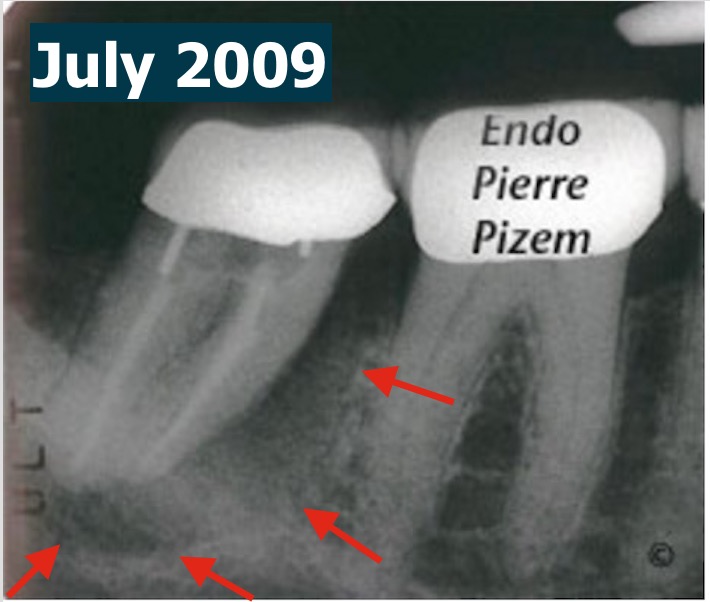
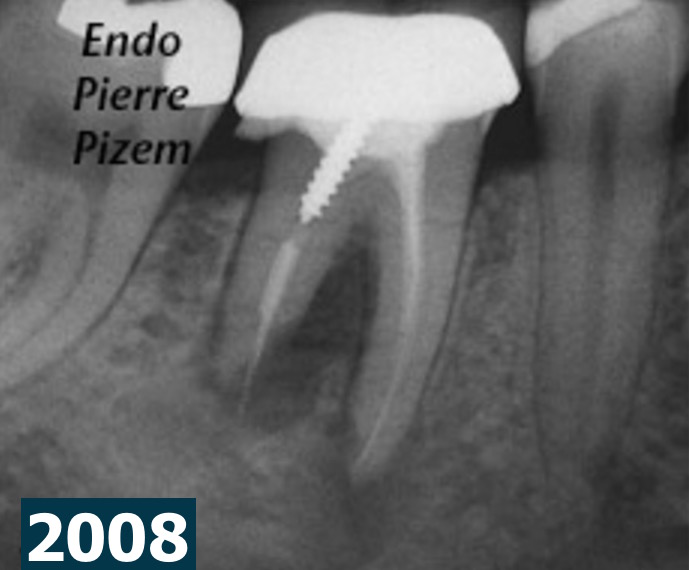
Patient was told seven years ago to remove lower right premolar and replace this tooth by an implant supported crown. Lack of periradicular tissues implied a guided tissue regeneration wich, in turn implied a bone curetage close to the mental foramen. Estimated health risk: A possible permanent nerve paresthesia caused by a curetage or by an implant surgery close to the mental foramen on a patient with a narrow crestal mandibular bone. A possible failure of guided tissue regeneration wich in turn, would impair implant osseointegration (or simply make the implant surgery impossible). Clinical examination revealed a mobility level of 2 and a sinus tract. Our findings on radiographic appearance: a large but a localised bony defect and a tooth that needed a root canal retreatment. Our suggestion to the patient: To put aside the implant surgery and to invest in a root canal retreatment with a few Ca(OH)2 replacements. The patient had to be patient (and faithful) for a few months in order to monitor progressive periradicular tissue healing. Results: Per and post operative control X ray films show a progressive, then complete healing of periradicular bone tissue. In this case, root canal retreatment proved to be a safe predictable way of saving that tooth at half the cost of an agressive implant surgery. Now, 7 years later, the tooth has it’s own casted post, a PFM crown and it’s mobility level came back to zero. And above all, patient is now completely safe from any paresthesia risk.
Read more

An endodontic retreatment procedure and a root end filling material (MTA) precision placement procedure, both performed using the dental operative microscope from Zeiss


case: 430646

Resorption associated with chronic apical periodontitis altered the shape and position of the foramen through osteoclastic activity, in the x ray images, the modified foramen in distal root is positioned farther from the radiographic apex and gutta percha appears in overextension. A large and circumbscribed radiolucency involves both roots as well as the furcation. This indicates an important periradicular tissues destruction. Tooth mobility level 2 goes along with this tissue loss.

This case is definitly a controversial one, meaning that it is possible for different practitionners to prognosticate endodontic success (very few among practioners) or failure with a great amount of disparity. As stated by John I. Ingles, a senior lecturer in endodontics: "The practicing dentist should not be cited for faulty judgment when even the so-called experts tends to disagree on prognosis… All in all, one must ultimately develop confidence in one's own abilities. Being able to practice using a great variety of techniques and not being "married" to a single approach in every case will greatly enhance one's capabilities. And on this is based good prognosis, the result of skill, knowledge, and self confidence."

Endododontic retreatment and MTA root-end fillings have been performed with a Zeiss Pro Ergo Microscope in september 2008. Last displayed X ray film on this post shows a 3 years post operative clinical outcome. Radiographic examination shows a complete regeneration of the periradicular tissues and a resoptive defect healing. 

Should an implant have been put there? maybe, maybe not!

Read more about MTA Precision placement with the microscope (.pdf)

Read more

When a “J” type lesion on an X ray image, as well as probing a “deep narrow periodontal pocket” could have missled the dental practioner to conclude the presence of a cracked tooth.


This is a case where, based on the X ray image of a "J" type lesion in combination with a deep narrow periodontal probing, one could easily think of a cracked tooth. However, when observing under high magnification, no crack could be seen from within the root canal mesial wall. This J shaped radiolucency was in fact a narrow desmodontal sinus tract originating from an endodontic infection. Saving that tooth implied a retreatment, a ledge bypass and a few calcium hydroxide dressings replacements. As shown on those control post operative X ray images, a slow but complete periradicular tissues regeneration occured. In this case study, even a CBCT 3D imaging would have shown a deep narrow bony defect that could have misled the practionner to conclude the presence of a cracked tooth. Direct observation under a dental operative microscope showed us otherwise, proving once more how micro dentistry is elevating endodontic care to a higher level. 

Read more

A huge radiographic “J” shape lesion, does the tooth has a vertical root fracture? a periodontal infection? an endodontic infection?


Case study number 456147

We have been presented with this mandibular second molar that has a periapical lucency which also has a periodontal component. Patient is experiencing pain. This radiographic image also shows a huge radiographic J-shaped lesion that may be indicative of a vertical root fracture in the mesial aspect of the mesial root. 

Are we dealing with a periodontal infection? And, if this is the case, such a periradicular tissues loss would command an extraction of the tooth. 

Are we dealing with a fracture? And, if this is the case, tooth extraction would also be the treatment of choice. 

Are we dealing with an endodontic infection? If this is the case an endodontic revision (endodontic retreatment) would suffice to preserve this tooth. 

The decision of extracting or saving that tooth should be based on a foundation of sound diagnosis.

One of the primary fact that needs to be established in distinguishing endo/perio lesion is the pulp status. Since there is not much pulp left in that case, pulp testing won't help much.

Periodontal probing is the next important measurement in determining if wether this tooth has an endodontic or periodontic infection. Probing shows no wide or narrow pocket on buccal neither on lingual (and on distal) aspects of this tooth, at this stage, periodontal infection might be ruled out.

The remaining question is: "Are we dealing with a fracture or an endodontic infection?" A deep narrow periodontal pocket would indicate a vertical root fracture and the quiz would end right there. The tooth would have to be extracted.The problem is that this defect, if it does exist, might be located just beneath a wide and tight mesial contact point and probing with accuracy this area is not that obvious. Hence the final question cannot be answered without any doubt by probing alone.

One option would be to remove the crown to allow for a direct access to the potential defect. But then, if no deep narrow periodontal pocket exist, the clamp for the rubber dam as well as tooth protection from vertical forces would require a provisional crown to be installed. Even so, probing a deep narrow periodontal pocket is not an absolute waranty that this defect is in deed a crack. It might also be a desmodontal sinus tract. Hence,drilling through the existing crown to access mesials root canals and a direct observation under magnifying lenses of a microscope seemed to be the appropriate way of confirming the presence or absence of a vertical root fracture. 


No crack could be observed from within the mesial root canals, the treatment has been completed in two appointments (third, fourth and fifth images) . Following the first appointment which implied material retrieval, irrigation and calcium hydroxyde insertion (Second X ray image), both pain and swelling disappeared. Following Xray image shows a complete periodontal tissue regeneration after one year. Tooth is asymptomatic.

Read more

The dental operative microscope and the MTA tooth perforation repair. The impossible made possible.

Case study number: 461716

Patient came to our office with spontaneous intermittent pain on maxillary right side. He can readily identify the tooth, he is showing the first molar. Patient is taking many Aspirin tablets per day and is tired of suffering.

Tooth history: first attempt of root canal treatment which ended up with a broken instrument.The patient was then seen two years ago by another practitioner who succeeded in the broken instrument surgical retrieval. Even thought, at the time, a complete retreatment has been performed, the tooth remained sensitive. Since then, painful episodes became more and more frequent with a growing pain intensity. 

Tooth is sensitive to palpation with a mobility of level 2. A new crown is protecting the cusps and occlusion looks fine. Pre operative Xray shows an apical periodontitis on mesio vestibular root and something that might be a perforation with a bunch of wispy gutta percha points into it. Patient is informed of this concern prior to starting anything. Patient is informed of the high incidence rate of a fourth canal in those first maxillary molars (Studies shows up to a whopping 92% rate). He is also made aware that this fourth canal may have been omitted. After the exam, patient knows that at least two concerns have to be addressed in order to solve his problem. Implant is suggested but patient is reluctant, he is 25 years old and he wants to keep his real tooth. 

The two first X Rays are preoperative

Third X rays show the recovered MB2 with a first instrument (number 08 ISO file) reaching its apex, the fourth X ray film shows the repaired perforation with MTA and intracanal medication (Ca(OH)2 dressing) in MB2. 

Fifth image shows immediate post operative outcome with the Pulp Canal sealer overfill which has no impact on the overall prognosis. An amalgam has been placed as a long term provisional for one year. Symptoms subsided almost immediately after the intra canal dressing. The monitored tooth has been fine all along for one year. The last Xray is a one year post operative control with a brand new crown in place.

Access made through crown makes the treatment much more difficult in that the landmarks that direct the clinician to the pulp chamber are removed. Our microscope integrated video camera recorded a short movie showing treated MB2 and the MTA repair, the position of the repaired perforation site (dark grey shade) in relation to the real position of the MB2, clearly stresses out what can happen while you are looking for the MB2 with external contour of the tooth being altered by a PFM crown. 

Read more